What Happens If You Skip ADAS Calibration After a Windshield Replacement
The windshield is replaced. The install looks clean. You drive away and nothing seems wrong — the car handles normally, the lane markings on the dashboard display look right, and you don't get any warning lights. So everything's fine, right?
Not necessarily. If your vehicle has a forward-facing camera mounted to or near the windshield — which includes most vehicles built since 2016 — and the camera wasn't recalibrated after the replacement, your advanced driver assistance systems are operating on incorrect data. The car doesn't know. You won't know. Until something goes wrong.
This is not a theoretical concern. It's the reason vehicle manufacturers and industry standards both require ADAS recalibration after any windshield replacement on equipped vehicles. Skipping it isn't just cutting a corner — it's introducing a silent error into systems you're relying on to keep you and other drivers safe.
What ADAS systems are — and what they depend on
Advanced Driver Assistance Systems is the umbrella term for the growing collection of electronic safety features that have become standard on modern vehicles. The most common include:
- Lane departure warning (LDW) — alerts you when the vehicle drifts out of its lane without signaling
- Lane keep assist (LKA) — actively steers the vehicle back toward the lane center
- Automatic emergency braking (AEB) — detects obstacles and applies brakes to prevent or reduce collision severity
- Adaptive cruise control (ACC) — maintains a set following distance from the vehicle ahead
- Forward collision warning (FCW) — alerts the driver when a collision risk is detected
- Traffic sign recognition — reads speed limit signs and other road signs
These systems work together and they all share a common dependency: the data coming from a forward-facing camera positioned behind the windshield, typically near the rearview mirror. That camera is the primary sensor for lane markings, vehicles ahead, pedestrians, and traffic signs. Its accuracy is not optional — it is the foundation of every decision these systems make.
How the windshield-mounted camera works
The forward camera on a modern ADAS-equipped vehicle is calibrated at the factory to know exactly where it is in three-dimensional space relative to the vehicle's centerline, height, and orientation. It knows its own angle of view down to fractions of a degree. That precise positioning is what allows it to accurately determine whether the vehicle is drifting toward a lane marking, how far away a car in front is, or whether an object ahead is on a collision course.
The camera communicates its position to the vehicle's control modules via a calibration file — essentially a set of reference values that tell the system what "straight ahead" and "level" look like through this specific camera, in this specific mounting position. When those values are accurate, the ADAS systems that depend on the camera work as designed. When they're off, every calculation downstream is affected.
The camera doesn't know if it's miscalibrated. It continues to function and output data — the data is just slightly wrong. The ADAS system has no way to self-diagnose this error without a calibration procedure.
Why windshield replacement disturbs the calibration
When a windshield is replaced, the camera must be detached from its mount, the old glass is removed, and the new glass is installed. Even if the camera mount returns to exactly the same position — and it rarely does with fractions of a millimeter of precision — the camera's relationship to the new glass is different. The thickness, refraction index, and surface geometry of the new glass, even if nominally identical to the original, introduce optical variation that affects how the camera perceives what's in front of it.
The camera mount itself can also shift slightly during the removal and reinstallation process. A deviation of one to two millimeters in camera position translates to a meaningfully different angular error in what the camera sees at distance. At 100 feet, a small camera angle error becomes a significant positional error. At highway speeds, where ADAS decisions are made in fractions of a second, that positional error is exactly the kind of thing that causes a late lane departure alert, a missed obstacle, or an adaptive cruise that maintains slightly wrong following distances.
What actually happens when you drive without calibration
The failure mode of an uncalibrated ADAS camera is not a warning light or a system shutdown. The system continues to operate. The car continues to report lane departure, forward collision, and adaptive cruise data. But the data is based on a slightly incorrect model of where the camera is pointing — and the consequences are subtle and inconsistent enough that many drivers never connect them to the missing calibration step.
In practice, here's what can happen on an uncalibrated vehicle:
- Lane departure warnings trigger early or late — the system detects a lane crossing that isn't happening, or misses one that is
- Lane keep assist steers the vehicle slightly off-center — the car tracks toward one side of the lane rather than the center
- Automatic emergency braking responds at the wrong distance threshold — braking earlier than expected, or critically, later than the system was designed to engage
- Adaptive cruise control maintains an incorrect following distance — the system thinks it's further from the car ahead than it actually is
- Traffic sign recognition misidentifies signs or reads them from the wrong position — leading to incorrect speed limit displays
- False alerts create driver distraction — repeated alerts for situations that aren't emergencies can lead drivers to disable the systems entirely, removing the safety net
The common thread: the car appears to be working normally because none of these errors are dramatic or sudden. They're small deviations that only reveal themselves in the situations where the safety system is most needed — and by then it may be too late to matter.
Why some shops skip it
ADAS calibration requires specialized equipment — a calibration target board, a scan tool with manufacturer-specific software, and for dynamic calibration, a controlled drive on a road with clear lane markings at a specified speed. Shops that don't invest in this equipment can't offer calibration as part of a windshield replacement. They have two choices: refer the customer to a dealership, or skip the step entirely and hope the customer doesn't notice.
Some shops skip it because including it makes their quote look higher than competitors who don't include it. A quote that omits calibration is cheaper on paper. It's also incomplete — and in some cases, it's the source of the ADAS errors that show up weeks later when a driver can no longer trace them to the windshield replacement that was done months ago.
When you're comparing quotes for a windshield replacement on an ADAS-equipped vehicle, confirm whether calibration is included. A shop that doesn't mention calibration at all may not be in a position to perform it.
The manufacturer warranty angle
Some vehicle manufacturers include provisions in their warranty documentation that require ADAS calibration after windshield replacement. Skipping calibration on these vehicles can void coverage for ADAS-related failures — meaning a malfunctioning AEB or LDW system that would otherwise be covered under the manufacturer's warranty may be denied if the calibration requirement wasn't met after the last windshield replacement.
This is particularly relevant for higher-end vehicles and newer models with extensive ADAS packages. If your vehicle is under manufacturer warranty, it's worth confirming whether calibration after glass replacement is a warranty requirement for your specific make and model. Our technicians are familiar with the requirements for most vehicles we service and can advise you directly.
Static vs. dynamic calibration
There are two types of ADAS camera calibration, and the type required depends on your vehicle's manufacturer specification:
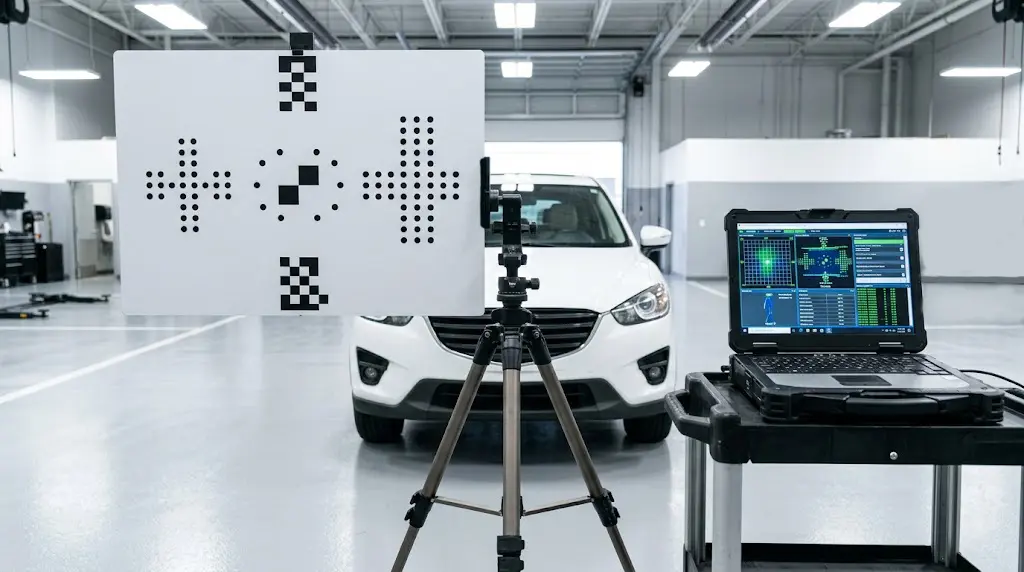
Static calibration is performed with the vehicle parked on a level surface in a controlled environment. A calibration target — typically a pattern board with precise geometry — is positioned at a specified distance and angle in front of the vehicle. The diagnostic tool communicates with the camera system and adjusts the calibration values until the camera's output matches the expected reference frame. The entire process happens with the car stationary and takes roughly 30–45 minutes.
Dynamic calibration requires a drive. The vehicle is driven at a specified speed on a road with clearly marked lane markings, allowing the camera system to self-correct its calibration values using real-world lane data. Some vehicles require only dynamic calibration; others require only static; some require both. The dynamic portion typically adds 15–30 minutes to the appointment.
The specific procedure required is determined by the manufacturer, not by the shop. A technician performing calibration on your vehicle uses the manufacturer-specified procedure for your exact year, make, and model — not a generic approach.
How Flux handles it
When you book a windshield replacement with Flux Auto Glass, we check your VIN before the appointment to determine whether your vehicle requires ADAS calibration. If it does, calibration is scheduled as part of the same appointment — not as a separate trip or an add-on you have to request.
Our technicians carry the equipment to perform both static and dynamic calibration on-site at your location. After the calibration is complete, we provide confirmation that the procedure was performed and completed successfully. You don't need to make a second trip to a dealership or a diagnostic shop, and you don't need to take our word for it — the calibration is documented.
For vehicles where calibration is included in the insurance claim, we handle billing for it the same way as the windshield replacement — directly to your insurer, no out-of-pocket cost to you.
If you have questions about whether your specific vehicle needs calibration, visit our ADAS calibration page or call us at (800) 793-5894. We’ll look up your VIN and tell you exactly what your vehicle requires.