
ADAS calibration done in the same appointment.
If your vehicle has lane-departure warning, automatic emergency braking, or adaptive cruise control, replacing the windshield without recalibrating the forward camera is only half the job. We do the other half — on-site, no dealership trip required.
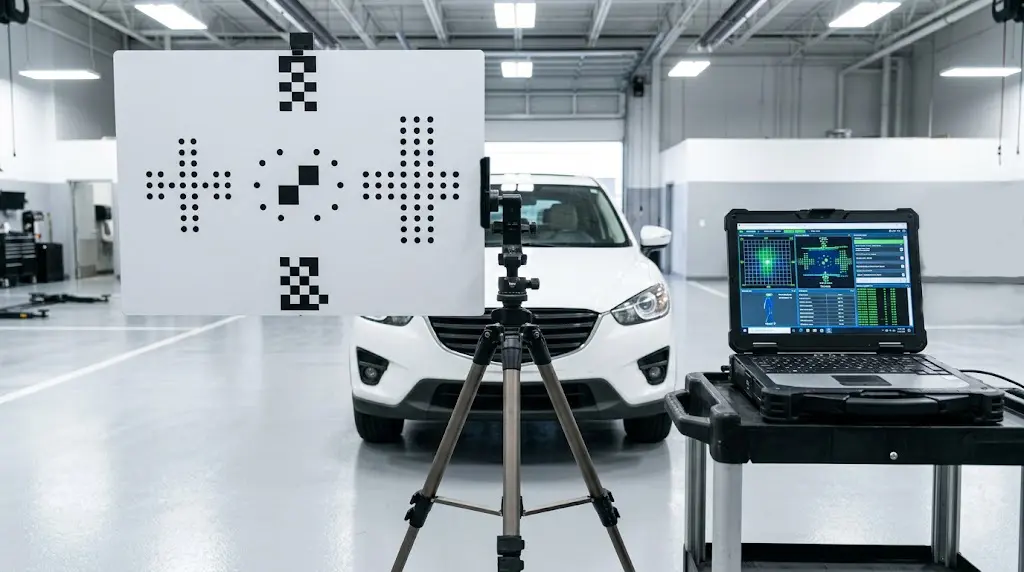
The camera behind your safety systems has to be aimed right.
Most vehicles built after 2016 have a forward-facing camera mounted to or directly behind the windshield. That camera is the primary sensor for features like lane-departure warning, automatic emergency braking (AEB), adaptive cruise control, traffic sign recognition, and forward collision warning.
When a windshield is replaced, the camera's physical position changes — often by less than a millimeter. That's enough. The camera's field of view shifts, and without recalibration, it interprets the road incorrectly. In mild cases, it triggers warnings at the wrong time or not at all. In serious cases, automatic braking or lane-correction functions can behave unpredictably.
Many auto glass shops skip this step — either because they lack the equipment or because they're quoting low to win the job. A shop that can't show you a calibration report hasn't completed the job.
Static, dynamic, or both — we handle all of it.
Your vehicle's manufacturer specifies which procedure is required. We follow manufacturer protocols for every make.
Static calibration
The vehicle is parked in a specific location relative to a calibration target board. Using manufacturer-specified measurements, the tech positions the target at precise distances and angles in front of the camera. Diagnostic software then reads the camera feed and adjusts the calibration parameters until the image aligns to spec.
On-site at your location — driveway, open parking lot, or garage. The surface needs to be reasonably flat and there needs to be enough clear space in front of the vehicle. Most residential and commercial locations work fine.
Dynamic calibration
The vehicle is driven at a set speed (typically 25–45 mph) on a road with clear lane markings while the ADAS system runs its self-correction routine. The diagnostic software monitors the calibration in real time and confirms when the system locks to spec. The drive typically takes 10–20 minutes.
Your Flux technician handles the calibration drive. The vehicle is returned to your location afterward. If you'd prefer to be present or have the tech drive with you, we accommodate that — just let us know when booking.
We calibrate all major makes.
Our technicians train on each manufacturer's specific calibration procedures and diagnostic requirements. Here's a sampling of what we calibrate.
Don't see your make or system listed? Call us — our technicians cover nearly every ADAS platform on Arizona roads.
One appointment, all the way through.
We identify your ADAS requirements at booking
When you provide your VIN or vehicle details, we look up whether your vehicle requires calibration, which type (static, dynamic, or both), and what equipment your manufacturer specifies. Everything is confirmed before we arrive.
Glass replacement comes first
We install the new windshield and allow the adhesive to cure to the manufacturer's minimum drive-away time before touching the ADAS system. Calibrating before the glass is fully seated would produce an incorrect baseline.
Calibration is performed and verified
Static calibration begins with precise target placement per manufacturer spec. Dynamic calibration follows with a calibration drive. In both cases, the diagnostic tool must confirm a successful calibration lock before we consider the job complete. We provide the calibration report.
Mobile across the entire Valley — and now Tucson.
If you're anywhere in the Phoenix metro or Tucson, we'll come to you. Pick your city for response times, neighborhoods served, and local details.
ADAS calibration, answered.
Replace the glass and calibrate right.
Same appointment, no dealership trip. We identify your ADAS requirements before we arrive — and confirm calibration is locked before we leave.