
Can a Cracked Windshield Be Repaired? (Or Does It Need Replacement?)
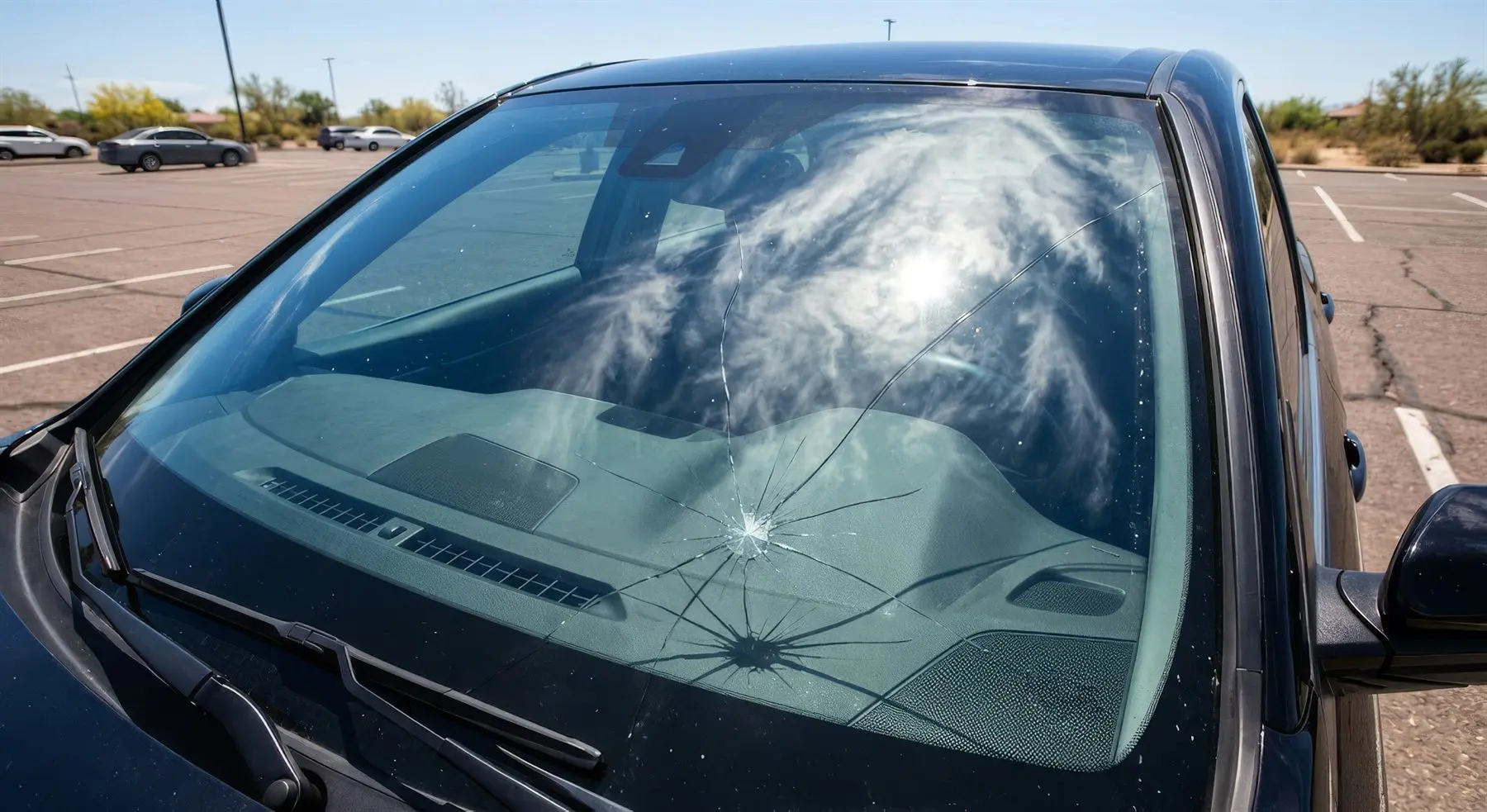
It's the most common question we get: "I have a crack in my windshield — can it be fixed, or do I need a whole new one?" The honest answer is that it depends on three things: how big the damage is, where it's located on the glass, and whether it's been contaminated by water or debris. Get those three factors right and the answer is almost always clear. Get them wrong — or wait too long — and a $0 chip repair turns into a full replacement that costs more time and money.
This guide walks through exactly how the repair-or-replace decision gets made, what the limits are, and why Arizona's climate makes timing especially important.
The repair-or-replace decision comes down to three things
Every chip and crack assessment starts with the same three-factor evaluation: size, location, and contamination. A technician who skips any one of these isn't doing a thorough assessment. All three matter, and any one of them can take a repairable chip and make it a replacement job.
Size tells you whether the physical damage is within the limits of what resin can structurally restore. Location tells you whether repair is safe — a repaired chip in your direct line of sight creates a distortion that can be as dangerous as the crack itself. And contamination tells you whether the repair is even chemically possible: if the crack has been filled with water, road grime, or wax, the resin cannot bond correctly and the repair will fail.
Size guidelines — smaller than a quarter (chip), shorter than 6 inches (crack)
The industry standard for repairability is straightforward: chips smaller than a quarter in diameter and cracks shorter than six inches can typically be repaired. These aren't arbitrary limits — they reflect the structural boundaries of optical resin injection. Beyond those dimensions, the damage affects too large a section of the laminate to restore to a safe structural state.
That said, size alone doesn't guarantee repairability. A chip that's smaller than a quarter but sits directly in front of the driver is still a replacement job. And a crack that's five inches long but runs from the edge of the glass inward typically needs replacement regardless of length — edge damage propagates under structural load in ways that interior cracks don't.
The practical takeaway: when in doubt, get it assessed before assuming. A chip you think is "too big to fix" may still be within limits, and one you think is "probably fine" may already be disqualifying.
Location matters as much as size
Where the damage sits on the windshield affects two things: the safety of the repair and the structural risk of leaving it unaddressed.
Anything in the driver's primary line of sight — the area directly in front of the steering wheel — is generally not a repair candidate. Even a successful resin injection leaves some optical distortion at the impact point. That distortion in a peripheral area of the glass is usually acceptable. In your direct line of sight while driving, it's a hazard. Most technicians will not repair damage in the driver's sightline and will recommend replacement instead.
Edge damage — cracks or chips within roughly two inches of the glass border — is also treated differently. The edges of the windshield bear structural loads from the vehicle frame. Damage near the edge is more likely to propagate under road vibration and thermal stress, and resin repair at the edge doesn't hold as reliably as it does in the interior of the glass. Edge damage typically means replacement.
Contamination makes repair impossible
The resin used in windshield chip repair is injected into the void created by the impact, then cured with UV light to harden and bond with the surrounding glass. For that bond to work, the void needs to be clean and dry. If water has entered the crack — from rain, a car wash, or even morning dew — the resin can't displace it fully, and the repair will either fail or bond improperly, leaving a weak spot in the glass.
The same applies to road grime, wax, cleaning products, and anything else that may have worked its way into the crack. A contaminated chip is not repairable. It requires replacement.
This is one of the most important reasons not to wait. A fresh chip in dry Arizona summer weather is almost always repairable. The same chip after a week of temperature cycling, a rainstorm, or a visit to the car wash may not be.
Why Arizona heat makes this urgent
Arizona's climate creates conditions that are unusually hostile to unrepaired windshield damage. The combination of intense daytime heat, cold overnight temperatures, and the thermal shock of air conditioning creates repeated expansion and contraction cycles in the glass. Each cycle works on the crack, widening it microscopically, pushing it toward the edges, or turning a small star fracture into a full-length crack.
In the summer months, the interior of a parked car can reach temperatures well above 150°F while the exterior sits at ambient air temperature. That differential creates real stress on any pre-existing damage. A chip that might stay stable for weeks in a milder climate can spread into a crack within days in Phoenix — sometimes within hours after parking in the sun.
Road vibration compounds this. The same crack that's holding steady at the moment you park can propagate the moment you hit a freeway on-ramp. Arizona highways are not smooth, and the vibration from road surfaces is a constant mechanical stress on any structural damage in the glass.
The practical message: if your chip is repairable today, it may not be tomorrow. Getting it assessed quickly — and repaired or scheduled for replacement — is not urgency theater. It's how you stay in the cheaper, faster option instead of the one that takes an hour and requires a full new windshield.
What happens during a repair
Windshield chip repair is a straightforward process when the damage qualifies. The technician begins by cleaning the damage area and ensuring the void is dry and free of debris. A vacuum bridge is placed over the impact point to draw out any remaining air, which creates an even better bond environment for the resin.
Optical-grade resin — a clear, liquid polymer with the same refractive index as the glass — is then injected under pressure into the crack or chip void. Pressure injection ensures the resin fills the entire void without air pockets. Once filled, the resin is cured with a UV lamp, hardening it in place. The technician then polishes the cured surface to reduce surface distortion and checks the result optically.
The whole process takes about 30 minutes. When it's done correctly, the structural integrity of the glass is restored. The original impact point will typically still be faintly visible at certain angles — that's normal, and it's different from a distortion in your line of sight. The goal of chip repair is to stop the crack from spreading and restore the structural strength of the laminate, not to make the glass look factory-new.
When replacement is the only option
Some damage always requires a full replacement, regardless of other factors:
- Cracks longer than six inches
- Chips larger than a quarter in diameter
- Any damage in the driver's primary line of sight
- Edge damage within approximately two inches of the glass border
- Multiple chips or cracks in the same area of glass
- Damage that has been contaminated by water, wax, or debris
- Damage to the inner layer of the laminate (internal cracks that appear cloudy or white)
- Any crack that has already spread significantly from the original impact point
Replacement also becomes the right call when a vehicle has multiple smaller chips that, while individually repairable, collectively compromise the structural integrity of the glass. A windshield with four or five repaired chip spots is not the same structurally as a fresh windshield — and at some point, replacement is the more honest answer even if each individual chip technically meets the repair criteria.
How Flux helps you decide
Flux Auto Glass technicians assess the damage before any work begins. We don't upsell replacement if repair will do the job, and we don't attempt repairs on damage that genuinely requires a new windshield. The assessment is honest: size, location, contamination — all three factors evaluated, the result explained clearly, and the recommendation made without pressure.
If your damage is borderline, we'll tell you that too. Some chips are right at the size limit, or sit close enough to the sightline that the repair outcome may not be ideal. You deserve to know that before you commit to either option.
If you're not sure whether your damage is repairable, the fastest answer is a photo. Text us a clear image of the damage at (800) 793-5894 and we'll assess it and respond with an honest recommendation — usually within a few minutes. You can also visit our chip repair page for the full decision guide and to start a quote.
The sooner you get it looked at, the better your options are. Arizona heat doesn't wait — and neither do cracks.